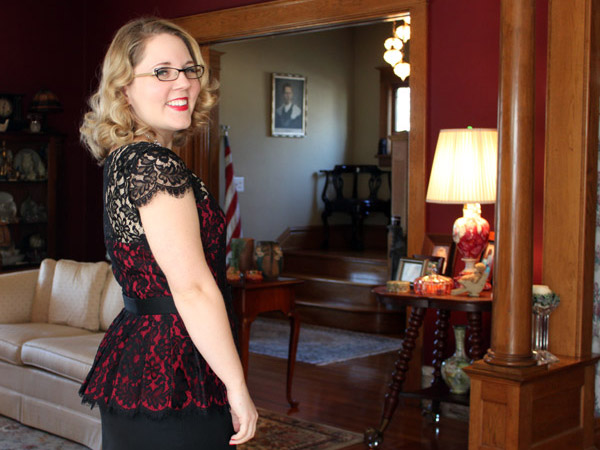
I’ve been in serious need of blouses in my wardrobe; skirts I have loads of, but there’s a significant shortage of blouses.
I went and pulled out all of the blouse fabrics I have in my stash and selected out a few of those that would work for the springtime. Then separately, I went though all of my blouse patterns and selected out the ones I actually wanted to make.
One of my fabrics that I’ve been hesitant to use is a 3-ply silk crepe fabric. Silk crepe is my FAV fabric of all time and while my inclination is to hoard it, I know I’d love it even more if I used it for a blouse that I could wear. I have certain patterns in my stash that lend itself wonderfully to the drapey silk crepe, the Vogue 5011 is the one I choose to pair with my navy-colored crepe.
I decided that this simple blouse needed some embroidery and set about looking on the flickr group: Hoop Love Vintage Transfers. I picked out a few that could work, but choose this little bird transfer.
Every time I think of birds on fabric (or on anything really) I can’t help but chuckle and think of Portlandia’s Put a Bird on It. I contemplate if I like the item simply because it has a bird on it… Most times that’s the case, but I still can’t help it. Birds are cute and make everything better. So I’m putting a bird on my blouse. heh
I’m a total newbie when it comes to embroidery, as I’ve only done one embroidery project in the past. So I’m still choosing very simple designs that I can complete with a few stitch types: stem stitch, daisy stitch, back-stitch, and running stitch.
I decided on this color scheme: 3 blues for the bird, 2 corals for the flowers and two greens for the stems and leaves. I went to Joann’s knowing I wanted a blue for the bird, but I always bring my fabric swatch & embroidery pattern so I can select the colors, all the while building around the blue and seeing what shows off well against the navy fabric. Oftentimes I wander to the front of the store that has the natural lighting, to ensure that I’ve chosen decent colors. I’m not sure about your local craft stores, but the fluorescent light can throw things off in a strange way.
I love incorporating multiple shades of the same color within a project, as I think it gives the embroidery a bit more depth and looks somewhat more professional as I’m just starting out.
I taped my transfer directly onto the front of my blouse, pre-stitching.
And I used some wax-free transfer paper and my knitting needle to trace the design onto the fabric.
I ALWAYS test these things out on scrap fabric first. Sometimes I can use a pen as the tool to transfer the design, but I found that my knitting needle does the best job of transferring the image to the fabric.
Transferred design:
The one thing I didn’t test was the durability of my transfer. As soon as I started stitching the bird’s head the rest of my transfer markings were falling off of my fabric. *yarr!* So I basically had to wing-it as far as replicating the original transfer design.
The bird is similar, but you can totally see some differences in mine vs. the transfer.
Most of these images are taken on separate nights too. My work has kept me really busy and all of last week I only managed to embroider for 45 minutes before needing to head to bed. So instead of spending all night to finish the design, I was at this for 4 nights.
My favorite part of the design was the flowers. Those little bits of coral-pink really cheered me up as I was working on them.
I removed the hoop and you can still see the imprint that it’s left. I’m hoping this will lessen after I was it for the first time.
While it’s not perfect (or as nice & tidy) as my first embroidery attempt, I think it looks pretty cute and ‘makes’ this blouse.
I currently have three blouses in the works, but my birdy blouse is the closest to being completed of the three, even with the addition of some embroidery. Over the weekend I was able to stitch the rest of it up, and the only thing I have left on it is the hemming (as always). I’m already planning on making a few more as it’s such a great basic blouse for the summer or for layering over in the winter.
Hope you all had a great weekend!
The weather cleared up in Chicago (finally!) for me to go out and take some photos. It’s still quite cold, which was a plus since I was taking photos of my long-sleeved Spring Suit Jumper. Otherwise, I can’t wait for it to get warmer so I can go out in the rest of my recently completed items.
I believe I started this Jumper back in August (2012) and I stopped and started a few times since then.
I used Berocco Ultra Alpaca Light which is a sport weight yarn comprised of 50% alpaca and 50% wool. While this jumper may look very light, it’s quite heavy with the alpaca content.
Since the pattern originates in 1936, I paired it with my drop-waisted skirt, lace-up shoes and a curly top. I’m not certain I have an authentic 30′s look; it ended up more of a modern 30′s throwback instead.
I reworked the original pattern a decent amount. The stitch counts and shaping are roughly the same, with the exception of shortening the armscye and narrowing the shoulders. But the changes that I did are mainly cosmetic.
This knit was supposed to be purl stitches throughout the body of the jumper, whereas I made them all knit stitches. I also added one of the stitch patterns from the bodice onto the sleeves.
And I also modified the collar/bow.
I made the collar wider but I also shortened the length of the bow. Instead of creating a bow, like you would doing your shoe-laces, I instead knit a small circular loop and fed the tie trough the loop. So it looks like it has a knot, but it really isn’t.
The reason I did this was that the bow tie was going to be way too thick and bulky (due to my yarn choice) for my top and it would going to end up covering the entire bodice, which I didn’t want.
Even after reducing the width of the shoulders, I found that they still drop lower than my actual shoulders do. It wasn’t enough to bother me so I just left them as is.
While I wouldn’t recommend using this yarn for your own Accessory for Your Spring Suit Jumper, I’m happy I used it up. You see, I’ve had this yarn longer than I care to admit (easily over 4 years). Back before I knew how to knit when I was only crocheting, I had used it to crochet up a sweater which was an epic fail. So it was sitting forever in my closet as half of a crocheted jumper and it really needed to be frogged. This jumper seemed like it would be a good match for the yarn and I frogged my crocheted top and started knitting this up.
The yarn isn’t terrible paired with this jumper, but this is the first time I’ve worked with alpaca. And it just ended up a bit heavier than I thought it would. It’s not bad since it will be a god-send in the middle of the Chicago winter, but it just made the neckline and bow a bit tricky to execute.
I had a lot of fun doing my hair for these photos.
I was telling Felix, I feel like I have a feau-hawk of curls.
I only curled the top half of my hair earlier in the am and left the whole bottom section flat. To do my hair, I did a french twist on the flat bottom half and lightly unpicked the curls and pinned them to the top of my head in a pleasing way.
My hair is just shy of being shoulder length, so the french twist took me two tries but I was able to pull it up just fine.
I could have pinned some of the curls a bit higher onto my crown, but I still think it was a pretty fun do. I felt like there was a party on my head the rest of the night since I left my hair like this for the remainder of the evening on Saturday.
Come Sunday morning, my curls were pretty much intact since I didn’t brush them. I was able to execute my FIRST successful pin curl for Sunday brunch!
I made two pin curls at the front and pulled the rest back into a high (mini) pony tail.
Woot for pin curls!!! Seriously, I’ve tried several times to do these and they were always an epic fail. I think the key to them is having your hair curled before hand vs. doing them with straight hair like I’ve tried in the past.
Hope you all had a pleasant weekend and that the weather is more spring-like, wherever you are.
It’s been quite a while since I’ve posted up some patterns for you all! I was going to blog about my most recent sewing project/s but I figured that could wait till Monday.
This pattern comes from the February/March 1944 edition of Stitchcraft Magazine.
Click on the following link to download the pattern as a pdf: Embroidered Jumper Pattern
While it’s not what I think of as typical embroidery, this jumper is wonderful. I love those tailored-looking knits and this one is just as good as the rest, don’t you think?!
Pattern Details:
There are pattern details for two sizes: 32-34 and 36-38″ bust ranges. What’s interesting is that the stitch counts are exactly the same for each size, what changes is the type of yarn that was used, and the needles/gauges along with it.
The 32-34″ bust size calls for a fingering weight yarn with a tension of 8.5 sts per inch whereas the 36-38″ bust calls for a 3-ply yarn ( also a fingering?) with a tension of 7 sts to an inch.
The 32-34″ bust calls for US 2 or 3.00 mm needles for the main body of the jumper and the 36-38″ bust calls for US 5 or 3.75 mm needles.
The larger size technically uses a fingering weight yarn, but I wouldn’t worry so much as getting the fingering weight, as getting a nice tension swatch for 7 sts per inch that you’re pleased with.
For me, I’d consider a sport weight yarn and would swatch it to see what the tension was looking like with the US size 5 needle, and adjust as needed from there.
Another nice design feature on this jumper is that it has a short sleeve AND a long sleeve option. Isn’t that nice?! While I love short-sleeved knits, I never do get a lot of wear out of them since my arms always get cold. Yet I still find myself knitting them time and time again. heh
Hope you like my pick for today. Also, feel free to post a comment letting me know if there’s any particular type of knit you’d like to see me post up here. Cheers!
For all of my US readers, I’m sure you know that this time of the year is tax season. Fun Fun.
When I was 16, my dad taught me how to do my own taxes and I have been doing them on my own ever since. But when I got married a few years back, I deferred to my hubby and we went to his tax guy. Changing from single to married status, I wasn’t certain if there were any new tax things I was unaware of, so I thought it best to go see a professional.
But this year I decided I’d do them once again and save myself a bit of money in the process.
I don’t think you’ve seen my kitchen… I have an aqua theme going on. (All my dishes and small appliances are aqua too.)
Felix seemed quite impressed that I could do such a task, but to me taxes are really easy since I’ve been doing mine for over 10 years now. I mean we don’t own anything huge and we don’t itemize our deductions so those two things make doing taxes a (relative) breeze.
If I ever own a home or have to itemize, I believe I’ll be singing a different tune!
When I was chatting with Felix, I likened the tax form to a Choose Your Own Adventure book since on the 1040 there are notes that lead you to directions, and from there to schedules, and sub-schedules, etc. Felix seems to think we had read two different types of ‘choose your own adventure’ books. heh
Hope you are all well and have completed your taxes in time. And remember if you haven’t you can always file an extension without any major penalties (you may owe interest or incur minor penalties, but I’ve never had any issue with doing so in the past). :)
*Tune back tomorrow for more sewing/knitting posts as usual.*
While I’m still working on my Sun-Ray Ribbed Jumper, I’m not progressing as fast as I did when I was home sick (with nothing else to do) vs. when I’m back at work.
Thanks for all of your well-wishes btw. Felix and I are still coughing a bit, but I feel so much better than I did before, I may even start jogging again this week. :)
Back to the Jumper…
I’ve been knitting the Sun-Ray Ribbed Jumper in the round, from the bottom up. I always reference Ravelry when I begin any new patterns to see if there’s any errata or modifications that other folks did that may be worthwhile.
I prefer knitting in the round, but I saw that one lady on Ravelry, Aafke, even was able to join the sleeves while working in the round (ie no seaming) since this is a raglan-styled knit. This intrigued me to no end and I set upon the task of joining in my sleeves to the body of the jumper, while working the yoke, all in the round.
Aafke only noted what rows that she joined in her sleeves – the same row where you cast off (or decrease) for the armholes. But I had no idea how to go about such a task.
I did a Google search and found exactly what I needed along with this helpful diagram:
The stitches in red circles are the cast off stitches and the points where you join in the sleeves.
It’s really a simple idea but looks crazy to accomplish, well… to me it did. You knit across the front bodice of your jumper, place a stitch marker then knit across the sleeves, all on the same circular needles. Continue around the sleeve, across the back of the jumper, and across the other sleeve to the point where you started the row (on the bodice).
Like I said, it sounds easy enough, but it was a bit tricky to do since you’re dealing with extreme curves at either side of the sleeves. I learnt my lesson quick and am knitting this on two sets of circular needles.
Here’s my sleeve on the left and the body of the jumper on the right.
I knit my sleeve in the round with double-pointed needles. After knitting this second sleeve I proceeded to write out all the row-by-row directions so that I wouldn’t get mixed up.
On this pattern the ribbing on the sleeve is different from the ribbing pattern on the jumper. So at each sleeve, I switch to a different set of directions, but re-writing them all on one piece of paper makes easy work of keeping it straight.
I took this photo after I worked a few rows.
I really had to figure out how to do this, and get my needles straight before I could stop to take some pictures for you. (I didn’t want to lead you astray by showing you the ‘wrong’ way how to do this either.)
I have two sets of circular needles, each end stops around the mid-point of the sleeves. And I have 4 stitch markers noting where I joined in the sleeves.
Before the ‘beginning of the round’ was at one underarm-side seam of the bodice. When you join in sleeves, it’s much easier to use the ‘armpit’ marker (aka the new marker you placed when you began one sleeve) as the new ‘beginning of the round’ since that’s where my pattern changes.
Yes, I will be off by just one row, but it’s really not that big of deal in the long run, I doubt I’ll even notice at the end. heh The back of the jumper will have 1 more row than the front.
Detail:
There are 4 stitches on the bodice underarm and another 4 stitches on the sleeve’s underarm that are not worked and were placed on a scrap piece of yarn. This gap is what allows you to knit around the curve of the sleeve, since it provides some room to maneuver.

At the very end, I’ll have to connect these two sections together so that I don’t have huge holes. There are many ways to do this so I’ll research a bit more when I get to it. But I know you can graft them together, join them with a three-needle-bind-off, etc.
Detail Shot:
Do you see my row-by-row instructions I’ve written under the jumper?
The row count for the yoke of the body doesn’t match the row count for the sleeves, unfortunately. At the end, I found that I had 4 rows, in excess, at the sleeves so I will just decrease them when it’s least inconspicuous. If I’m feeling ambitious, I could always work those extra sleeve rows as short rows so that the body row count would stay the same while I’ve introduced some additional rows to the sleeves.
*Note* I do realize this isn’t a full-out tutorial and may not fully understand my steps. This is my first time doing such a task, but feel free to ask any questions if it’s not clear.
Hope you all had a nice weekend. It finally felt like Spring in Chicago, which was so nice and lovely to open my windows for some fresh air again.
Friends, I’m on a roll with knitting! I’ve been sick for a week and it was the only thing I could manage to do. While I’m feeling a bit better, I still can’t manage to stop.
My 9-5 day job has utterly drained me of all of my creative energy as of late, which is such a shame (but it’s most likely how I got sick in the first place). For my sewing projects, I literally only have to sew my coat hem and attach 1 button and I haven’t even have the energy to do that.
I spent my entire weekend/week plopped in front of our tv watching old movies and knitting. It’s been both bad and wonderful at the same time; bad since I’m not moving about but great since I’ve gotten so much knitting done.
I’ve knocked out 2 knitting projects off my list and I’ve started in on the third:
Green Bobble Jumper: CompletedAccessory for your Spring Suit Jumper:Newly CompletedAqua Waves Jumper:Newly Completed- Sun Ray Ribbed Jumper: In Progress
- Basque Cardigan
- Cropped Swing Jacket
The bottom aqua jumper is the Aqua Waves, and the grey one on the top is my Accessory for your Spring Suit which I managed to finish up as of late.
I’m currently working on the Sun-Ray Ribbed Jumper (first image at the top of the post). I ended up knitting from just above the bottom ribbing all the way up to the armpits and I’m now working on one of the sleeves! It’s really crazy how much I’ve gotten done, but I’ve been sick with nothing else to do.
With how draining my work is at the moment, it’s nice to come home and do a bit of lounging & relaxing while keeping my hands busy with making things.
Is anyone else in a knitting frenzy at the moment???
Today’s post is all about my serger fuzz. Exciting right?!
So I know I should know better by now, but I’ve never cleaned out the fuzz in my serger… like ever. (We’re talking like 2 years here peeps!)
When I first started using it, for some reason I thought it was a self-sustaining machine. I thought this for far too long… and it’s quite silly that I did. I never thought about oiling, never thought about changing the needles, never thought about cleaning it out.
Before you start cringing and chiding me, I have taken a dust air gun thingy to it and blew out some fuzz from time to time. But I recently read that doing so is a big “No No” as it pushes fuzz further into the machine.
After I kinda realized that I should be doing regular maintenance on my serger, like any other sewing machine, I still didn’t. I was worried about what lay inside the serger and consequently avoided it.
About a month ago the fabulous Lauren of LLadybird posted up a wonderful post about sewing machine maintenance. After reading, I decided to take change of my serger and clean it out.
I started taking out screws (noting where they came from so I could reassemble my machine) and started brushing it.
It doesn’t look too bad…
But here’s another angle.
First I should say… I don’t remember the last time I’d even sewn with red fabric. But see all of those red fabric bits?! I have no idea what project they’re from!
Is this image blurry or is it just covered in that much fuzz? I’ll leave it to you to decide.
While you may be saying that doesn’t look terrible… It really was.
After sucking up fuzz and threads with my vacuum, I took one of those firm little brushes to the machine and got brushing.
This is then what I got out of the serger:
That big chunk of greenish fabric (lower left), that’s from this skirt… which I made last March. Yikes!
I did many bouts of vacuuming, brushing, and air-dusting to the machine. Once I was happy with the insides, I oiled it and put it all back together. I even changed the needles on it.
So… while cleaning it was an adventure in what fuzz came from which project & how old does it date. I now know better. So being a good little seamstress, I went and dusted out my other regular sewing machine in hopes of building up some good karma.
All in all, I’m lucky my serger hasn’t broken or seized up from the abuse I’ve given it. And really it’s a testament to how much I can throw at it without it breaking. But that being said, I aim to clean out my serger a bit more regularly in the months to come since I’d hate to have it break on me as a result of silly neglect.
This begs the question… when’s the last time you guys have cleaned/oiled your own serger or sewing machine?
I can’t tell you how excited I was to start in on the outer collar. It made me feel like I was rounding the bend with the finish line in sight. Plus the collar was going to be a fun challenge…
Felix nabbed this picture of me as I was going about tracing some bodice and collar pattern pieces. What can I say… I work like a whirlwind (or perhaps it just looks like I do). heh
First and foremost, I’ve had this image in the back of my head as inspiration for my own collar:
I love how there’s that wisp of contrast color, starting from narrower to wider as you approach the shoulder edge of the collar. But instead of having the contrast at the very edge (consequently that’s how Gertie did hers as well), I wanted to have mine inset so you can see the fashion fabric at the very edge while the contrast was just inside that.
But how on earth can I accomplish such a thing?!
I spent at least half an evening playing around with some fabric scraps pondering how I was going to make this work…
I debated cutting a curve of my charcoal contrast fabric, using the collar pattern piece as the template and sewing it in. This seemed not only fiddly but also would entail a thicker outer collar with all of the seam allowances at the edge. It would be 3 seam allowances if I went this route. So instead I turned to applying the contrast piece on top of my fashion fabric, kinda like an applique.
After thinking about it some more and playing around with some waffle muslin, this seemed like it would work. I felt this was going to be the best option since it would enable me to physically manipulate the fabric width (& length) after laying it on the outer collar as I saw fit. If I went the pattern/sewing method I’d be having to sit down to the machine to stitch-unpick-restitch this area multiple times (many many times!)
As I was doing all of this my husband swung by to ask if I was documenting each and every step for you guys. Sadly, I said no…. Since I was really ‘winging it’ as to how I was going about each and every step of the contract collar process I didn’t really know what to photograph and when since I didn’t know the steps until the very end once I had the collar all done.
So if you’ll bear with me, I’ll show you a few pictures and describe it as best as I can.
First, I cut a 2″ strip of waffle weave muslin and placed it around the outer collar. I did so to give me a good sense of not only the width of the contrast fabric but also of the placement; how far away from the collar’s edge to place the contrast strip of fabric.
I decided that 2″ was a perfect width at the back of the neck and I had to taper it down to 1/2″ at the bottom edge of the collar. But… what I did differently was to keep the 2″ width for 14 total inches before starting to grade down to the 1/2″ width.
While this may seem easy-peasy, let me tell you it wasn’t. Not only was it tricky to cut the fabric since it was on the bias, but I didn’t cut the fabric at a straight angle. To create the wispy-like appearance I had to keep the curve in mind and graded it bit by bit.
This image just shows the placement of the outer edge of the contrast fabric.
From there I:
- Folded the collar in half and transferred these pin markings to the other side, in order to create a mirror image of the contrast fabric placement.
- Basted over the pin markings with some silk thread, and removed the pins.
- Pressed the seam allowances to the wrong side on the contrast fabric strip using 1/2″ seam allowances.
- Realized that I needed a smaller seam allowance at the bottom of the collar (since the contrast width was 1/2″ itself), and trimmed the seam allowance as needed.
I started pinning on the outside of the contrast fabric strip, working from the center back of the collar down to the front waist hem. Then I pinned the inside edge, easing in the fullness from the curve.
You can see how bubbly it all is.
From here I:
- Basted the contrast fabric with some silk thread, both on the inside and the outside curve.
- Pressed the outer edge to try to ease the fabric down flat, used lots and lots of steam!


All of my other images of the collar were out of focus (due to the poor lighting in my apartment in the evenings). But here’s a sneak peek of the collar after I stitched the front bodice lining (and another bias strip of contrast grey fabric) to the outer collar.
Next steps:
- Finish up the lining
- Restitch the outer bodice to the skirt (and reduce the seam allowance at the center back)
- Alter & stitch in shoulder pads
- Cut windows on the outer collar for my bound buttonholes
- Stitch in the lining into the bodice, by stitching all around the outer collar
- Hemming & other finishing
I’m hoping that I can get one bullet point item done each evening and that I finish my coat by the end of the (upcoming) weekend. I don’t want to kill myself with this coat, but I’d also like to wear it at least once before it gets too warm out.
I really should stop calling Butterick 5824 the Gertie coat, but this late in the game I can’t help it. I think you all know exactly what I’m talking about when I say the “Gertie Coat”.
Anyhow… after finishing up 4 of my sewing WIP’s (all skirts) I was debating starting something completely new to change things up and to reward to myself for finishing up so many languishing projects.
Here’s a quick rundown of my outstanding projects list.
Sewing Projects:
White Linen Simplicity 3673 Skirt: CompletedStriped Linen Simplicity 3673 Skirt: CompletedPurple Wool Dubarry 1884 B Skirt: CompletedMacaron Redux Dress: CompletedSimplicity 3313 Pinafore: Officially Abandonded- Butterick 5824 Coat (aka the Gertie Coat): In Progress
- Butterfly McCalls 4003 Dress
- Floral Vogue 7924 Dress
Knitting Projects:
Green Bobble Jumper: Completed- Accessory for your Spring Suit Jumper: In Progress
- Aqua Waves Jumper
- Sun Ray Ribbed Jumper
- Basque Cardigan
- Cropped Swing Jacket
Instead I had an desire to keep working down the list of projects that are uncompleted and decided to start up my Butterick 5824 coat once again. I started it primarily so I could at least wear it once before the winter is at an end… but we’ll see.
Where I left things:
- The skirt was stitched up, but felt way too wide and dumpy on my short, pear-shaped frame
- The bodice was completed, with the exception of the outer collar
- All linings needed to be drafted from my bodice pattern, cut, stitched and attached
These are the main components that need attention before I can move on so I dug in late last week.
I first got to work on the skirt which did take me more than 1 day for sure.
I had the same issue on the skirt of this coat, that I did on my recent completed purple Dubarry skirt. The width at the hem was too full for my short stature and created an out-of-proportion look that was not attractive.
I started little by little, taking out an 1″ at the hem (ie 2″ for both seam allowances) grading to nothing at the waist. It wasn’t enough. I kept reducing the hem by 1″ at a time until I got to 4″.
Again, this skirt has 6 seams, which I reduced each seam by 4″. This all means that I took out a total width of 48 inches at the hem! Even so, I feel like I could have gone a smidge narrower at the hem.
So while the hem started looking better, what this meant was that I had to unpick my side seam pocket and pocket facing that I had stitched (and graded the seam allowances already) and restitch it. What was frustrating was that I had to unpick and stitch this pocket on 3 times, mainly due to my own error. But still…. it’s really frustrating to have to redo your own work so many times to get it right.
After the skirt was completed, I basted it onto the bodice to see what it was looking like all stitched up.
The only issues I’m seeing after stitching the top to the bottom is:
1.) My bound buttonhole placement seems a bit too close to the seam. Only time will tell if this is a make-or-break- on my bodice.
2.) The length at the center bodice back seems too short.
Instead of looking like a flat (or parallel to the floor) seam, it looks as if it’s curving upwards.
I stitched the seam with a 5/8″ seam allowance so I’m hoping that I can stitch it with 1/4″ and it will look much better.
But my backup plan, that makes me feel like all is not lost, is that I have always been planning on making a tie belt for this coat. So if the seam does end up too high, the belt would cover it up in any event.
It’s not ideal, but it does make the coat wearable. And like I said, I had been planning on making a belt anyhow.
What’s up next is the outer collar. (Followed by all-things-lining and then all of the final construction.) So really it’s not too much before I can have a completed coat. But it’s always those little things that are unforeseen that end up taking the bulk of the sewing time…. I’m talking about you shoulder pads!


Hi, my name is Liz. By day I’m a research ayalyst; I work with data and run statistics all day long. But by night I’m all about creating things. I have a passion for making things and learning new skills... 


